# Load packages
library(tidyverse)
library(here)
library(janitor)
library(showtext)
library(glue)
library(ggtext)
library(arrow)
library(dplyr)
library(lubridate)

# Read in Eastern Panama Heating Data

p_east_lines <- readLines(here("posts", "panama-bleaching", "data","panama_pacific_east.txt")) # Create a vector containing each row

p_east_skip_rows <- which(grepl("YYYY MM DD", p_east_lines)) # Finds rows before date

ts_window <- 84 # Remove first 12 weeks for an accurate DHW rolling value

# Read the data
panama_east <- read.table(here("posts", "panama-bleaching", "data", "panama_pacific_east.txt"),
                     skip = p_east_skip_rows + ts_window, # Skip non row information at the top of the dataset and first 12 weeks
                     header = FALSE,
                     col.names = c("year", "month", "day", "sst_min", "sst_max", # Add column names
                                   "sst_90th_hs", "ssta_90th_hs", "hs_90th",
                                   "dhw", "baa_7day_max")) %>%
  mutate(site = "panama_east", upwelling = TRUE)

# Read in Western Panama Heating Data

p_west_lines <- readLines(here("posts", "panama-bleaching", "data","panama_pacific_west.txt")) # Create a vector containing each row

p_west_skip_rows <- which(grepl("YYYY MM DD", p_west_lines)) # Finds rows before date

# Read the data
panama_west <- read.table(here("posts", "panama-bleaching", "data", "panama_pacific_west.txt"),
                     skip = p_west_skip_rows + ts_window, # Skip non row information at the top of the dataset and first 12 weeks
                     header = FALSE,
                     col.names = c("year", "month", "day", "sst_min", "sst_max", # Add column names
                                   "sst_90th_hs", "ssta_90th_hs", "hs_90th",
                                   "dhw", "baa_7day_max")) %>%
  mutate(site = "panama_west", upwelling = FALSE)

# Read in bleaching grid data
bleaching_point_data <- read_parquet(here("posts", "panama-bleaching", "data", "point_data.parquet"))

# Create date and filter to Feb 2023 - Aug 2024
panama_east_filtered <- panama_east %>%
  mutate(date = as.Date(paste(year, month, day, sep = "-"))) %>%
  filter(date >= as.Date("2023-02-01") & date <= as.Date("2024-08-31"))

# Create date and filter to Feb 2023 - Aug 2024
panama_west_filtered <- panama_west %>%
  mutate(date = as.Date(paste(year, month, day, sep = "-"))) %>%
  filter(date >= as.Date("2023-02-01") & date <= as.Date("2024-08-31"))

##################### Plot Degree Heating Overtime ####################
# Combine datasets
panama_combined <- bind_rows(
  panama_east_filtered %>% mutate(site = "Upwelling"),
  panama_west_filtered %>% mutate(site = "Non-Upwelling")
)

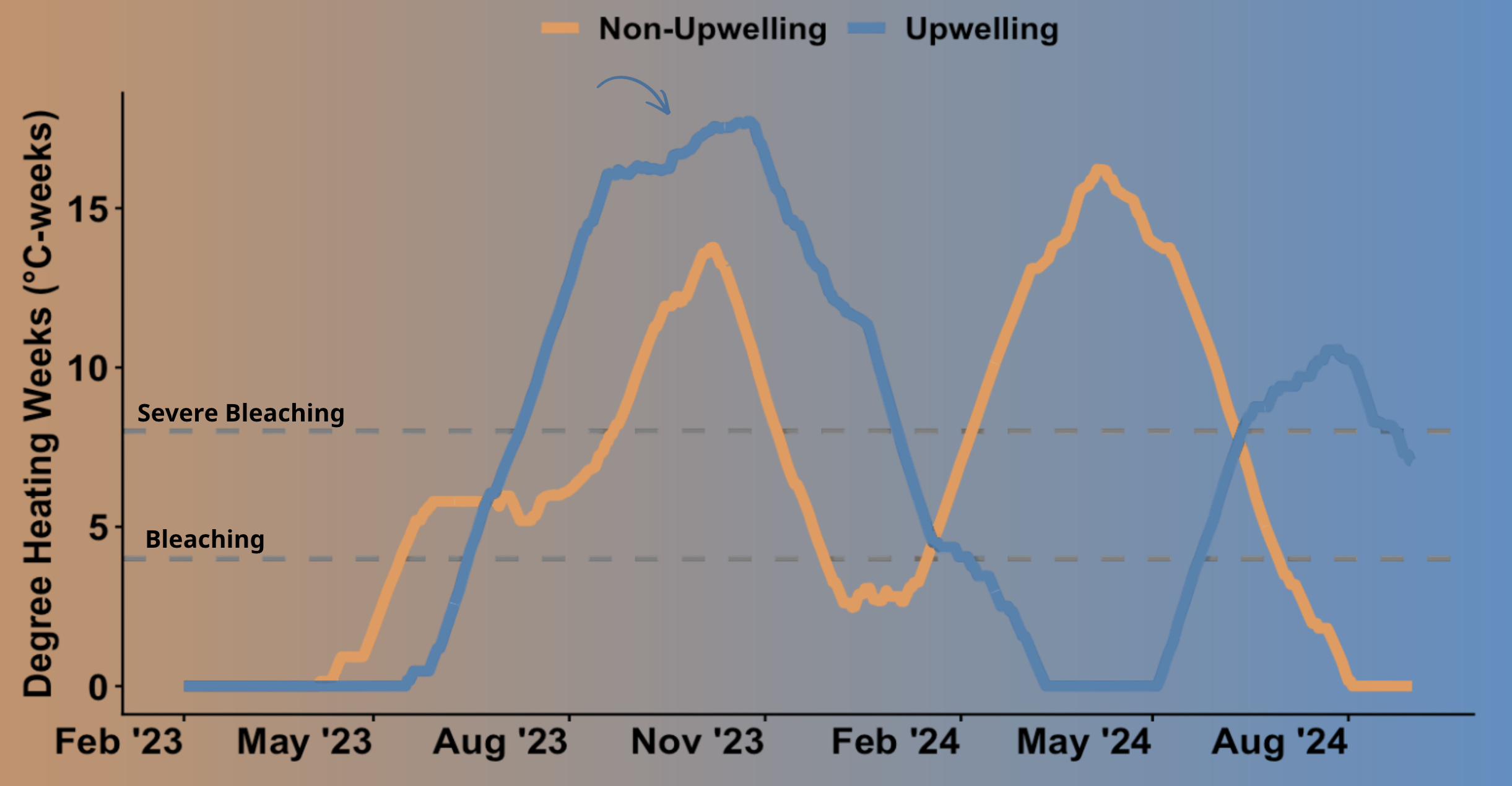
ggplot(panama_combined, aes(x = date, y = dhw, color = site)) +
  geom_hline(yintercept = 4, linetype = "dashed", linewidth = 2) +
  geom_hline(yintercept = 8, linetype = "dashed", linewidth = 2) +
  geom_line(linewidth = 2) +
  scale_color_manual(values = c("Upwelling" = "steelblue", "Non-Upwelling" = "darkorange")) +
  scale_x_date(
    breaks = seq(as.Date("2024-08-01"), as.Date("2023-02-01"), by = "-3 months"),
    date_labels = "%b %Y"
  ) +
  labs(
    title = NULL,
    x = NULL,
    y = "Degree Heating Weeks (°C-weeks)",
    color = NULL
  ) +
  theme_classic() +
  theme(
    axis.text.x = element_text(angle = 45, hjust = 1, size = 14, face = "bold"),
    axis.text.y = element_text(size = 14, face = "bold"),
    axis.title.y = element_text(size = 14, face = "bold"),
    legend.position = "top",
    legend.text = element_text(size = 12, face = "bold")
  )

#################### Calculate Bleaching Over Time ###################

# Remove non-coral points and unknowns
bleaching_cleaned <-bleaching_point_data %>%
  filter(class != "Background") %>%
  filter(class != "Unknown") %>%
  mutate(class = if_else(str_detect(class, "Bleached"), # Group bleaching severity
                         "Bleached", class)) %>%
  mutate(region = recode(region, # Assign site names to upwelling status
                         "Las Perlas" = "Upwelling",
                         "Coiba" = "Non-Upwelling"))

# Calculate coral status percentage per transect piece
 bleaching_recovery <- bleaching_cleaned  %>%
  group_by(region, site, piece, type, date) %>%
  summarise(
    Bleached = sum(class == "Bleached"),
    Alive = sum(class == "Alive"),
    Dead = sum(class == "Dead"),
    total_points = n(),
    .groups = "drop") %>%
  # Calculate coral status per piece to avoid swaths of coral bleaching affecting calculations
  mutate(bleaching_per = Bleached/total_points) %>%
  mutate(alive_per = Alive/total_points) %>%
  mutate(dead_per = Dead/total_points)

# Non-upwelling coral status percentage per transect piece overtime
non_upwelling_recovery <- bleaching_recovery %>%
  filter(region == "Non-Upwelling") %>%
  mutate(month = floor_date(date, "month")) %>% # monthly calculations
  filter(!month %in% as.Date(c("2022-09-01", "2025-04-01")))  # drop incomplete months

# Upwelling coral status percentage per transect piece overtime
upwelling_recovery <- bleaching_recovery %>%
  filter(region == "Upwelling") %>%
  mutate(month = floor_date(date, "month")) %>% # monthly calculations
  filter(!month %in% as.Date(c("2022-08-01", "2024-03-01", "2024-04-01", "2024-05-01"))) # drop incomplete months

# Average per date and type, then pivot long
upwelling_long <- upwelling_recovery %>%
  group_by(month, type) %>%
  summarise(
    mean_bleaching = mean(bleaching_per),
    mean_alive     = mean(alive_per),
    mean_dead      = mean(dead_per),
    .groups = "drop"
  ) %>%
  pivot_longer(
    cols = c(mean_bleaching, mean_alive, mean_dead),
    names_to = "status",
    values_to = "proportion"
  ) %>%
  mutate(
    status = recode(status,
      "mean_bleaching" = "Bleached",
      "mean_alive"     = "Alive",
      "mean_dead"      = "Dead"
    ),
    status = factor(status, levels = c("Dead", "Bleached", "Alive"))
  )

# Average per date and type, then pivot long
non_upwelling_long <- non_upwelling_recovery %>%
  group_by(month, type) %>%
  summarise(
    mean_bleaching = mean(bleaching_per),
    mean_alive     = mean(alive_per),
    mean_dead      = mean(dead_per),
    .groups = "drop"
  ) %>%
  pivot_longer(
    cols = c(mean_bleaching, mean_alive, mean_dead),
    names_to = "status",
    values_to = "proportion"
  ) %>%
  mutate(
    status = recode(status,
      "mean_bleaching" = "Bleached",
      "mean_alive"     = "Alive",
      "mean_dead"      = "Dead"
    ),
    status = factor(status, levels = c("Dead", "Bleached", "Alive"))
  )

# Create stacked area chart of upwelling bleaching mean proportion over time
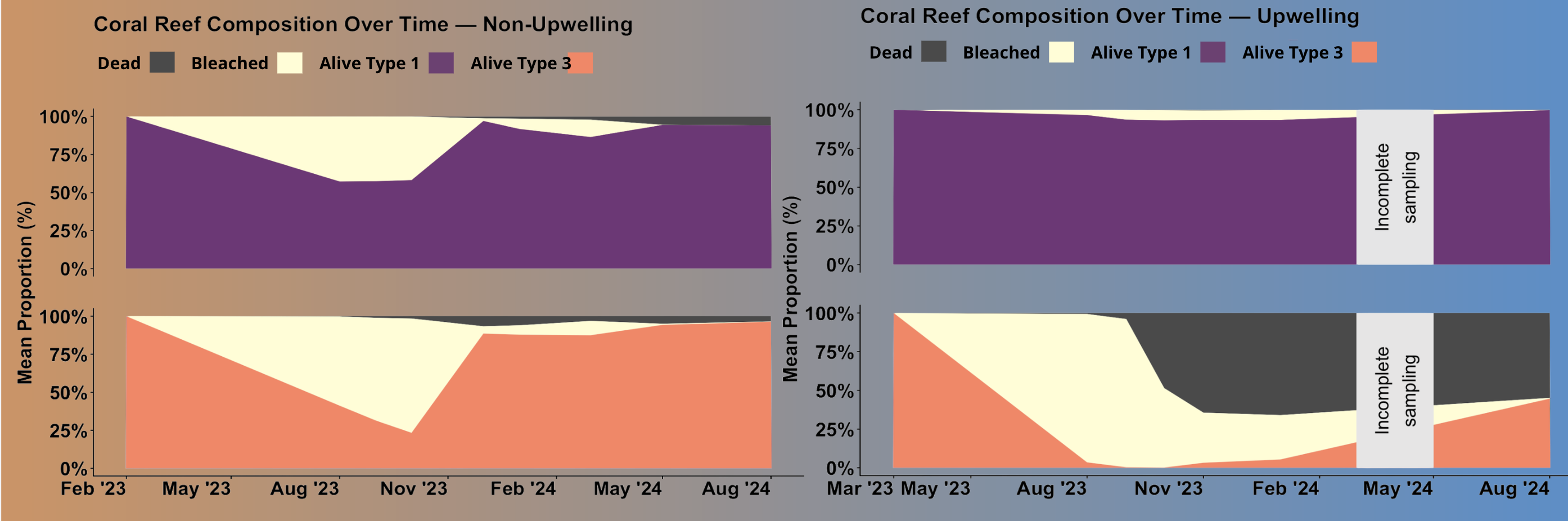
ggplot(upwelling_long, aes(x = month, y = proportion, fill = status)) +
  geom_area(position = "stack") +
  annotate("rect",
           xmin = as.Date("2024-03-01"), xmax = as.Date("2024-05-01"),
           ymin = 0, ymax = 1,
           fill = "grey90") +
  annotate("text",
           x = as.Date("2024-04-01"), y = 0.5,
           label = "Incomplete\nsampling", size = 6, color = "black", angle = 90) +
  facet_wrap(~ type, ncol = 1) +
  scale_y_continuous(labels = scales::percent, limits = c(0, 1)) +
  scale_x_date(
  breaks = c(
    seq(as.Date("2024-08-01"), as.Date("2022-08-01"), by = "-3 months"),
    as.Date("2023-03-01")  # add March specifically
  ),
  date_labels = "%b %Y"
) +
  scale_fill_manual(values = c(
    "Alive"    = "#FF7F51",
    "Bleached" = "#FFFDD0",
    "Dead"     = "#4A4A4A"
  )) +
  labs(
    title = "Coral Reef Composition Over Time — Upwelling",
    x = NULL,
    y = "Mean Proportion (%)",
    fill = NULL
  ) +
  theme_classic() +
  theme(
  strip.background = element_blank(),
  strip.text       = element_text(size = 18, face = "bold"),
  legend.position  = "top",
  axis.text.x      = element_text(size = 18, angle = 45, hjust = 1, face = "bold"),
  axis.text.y      = element_text(size = 18, face = "bold"),
  axis.title.y     = element_text(size = 18, face = "bold"),
  plot.title       = element_text(size = 20, face = "bold"),
  legend.text      = element_text(size = 16, face = "bold")
)

# Create stacked area chart of non-upwelling bleaching mean proportion over time

ggplot(non_upwelling_long, aes(x = month, y = proportion, fill = status)) +
  geom_area(position = "stack") +
  facet_wrap(~ type, ncol = 1) +
  scale_y_continuous(labels = scales::percent, limits = c(0, 1)) +
  scale_x_date(
  breaks = seq(as.Date("2024-08-01"), as.Date("2023-02-01"), by = "-3 months"),
  date_labels = "%b %Y"
) +
  scale_fill_manual(values = c(
    "Alive"    = "#FF7F51",
    "Bleached" = "#FFFDD0",
    "Dead"     = "#4A4A4A"
  )) +
  labs(
    title = "Coral Reef Composition Over Time — Non-Upwelling",
    x = NULL,
    y = "Mean Proportion (%)",
    fill = NULL
  ) +
  theme_classic() +
  theme(
  strip.background = element_blank(),
  strip.text       = element_text(size = 18, face = "bold"),
  legend.position  = "top",
  axis.text.x      = element_text(size = 18, angle = 45, hjust = 1, face = "bold"),
  axis.text.y      = element_text(size = 18, face = "bold"),
  axis.title.y     = element_text(size = 18, face = "bold"),
  plot.title       = element_text(size = 20, face = "bold"),
  legend.text      = element_text(size = 16, face = "bold")
)

# Calculate bleaching per coral type
type_coverage <- bleaching_recovery %>%
  mutate(month = floor_date(date, "month")) %>%
  filter(!(region == "Upwelling" & month %in% as.Date(c(
    "2024-03-01", "2024-04-01", "2024-05-01"
  )))) %>%
  filter(!(region == "Non-upwelling" & month %in% as.Date(c(
    "2022-09-01", "2025-04-01"
  )))) %>%
  group_by(region, site, piece, type) %>%
  summarise(points = sum(total_points), .groups = "drop") %>%
  group_by(region, site, piece) %>%
  mutate(piece_total = sum(points),
         proportion = points / piece_total) %>%
  group_by(region, type) %>%
  summarise(
    mean_proportion = mean(proportion),
    .groups = "drop"
  )
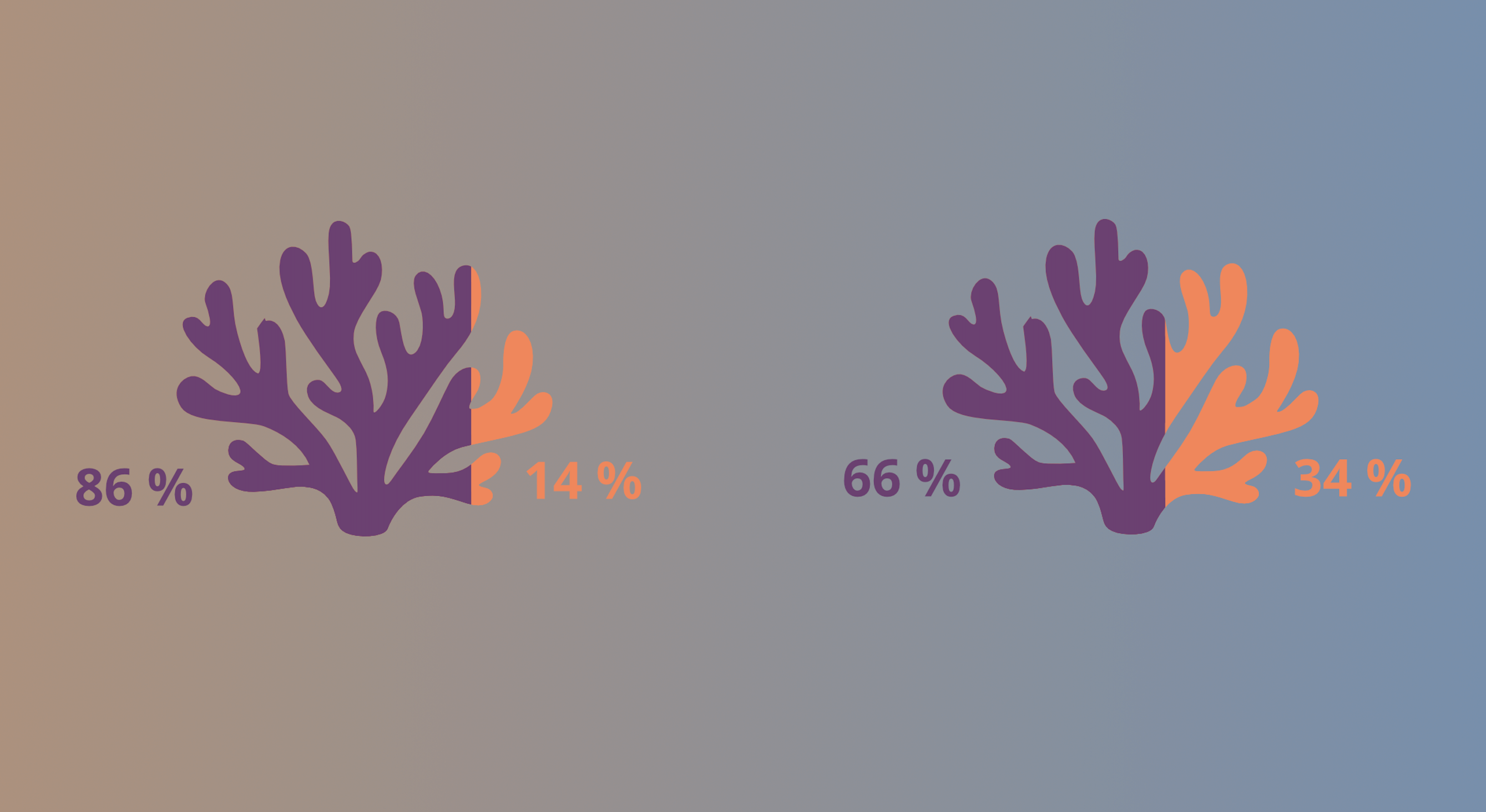
print(type_coverage)